Earth System Science Applications of Ocean State Estimation
Overview
For more than 10 years, the consortium for Estimating the Circulation and Climate of the Ocean (ECCO) has been developing advanced computational tools to reconstruct the day-to-day state of the Earth's ocean and sea-ice system.
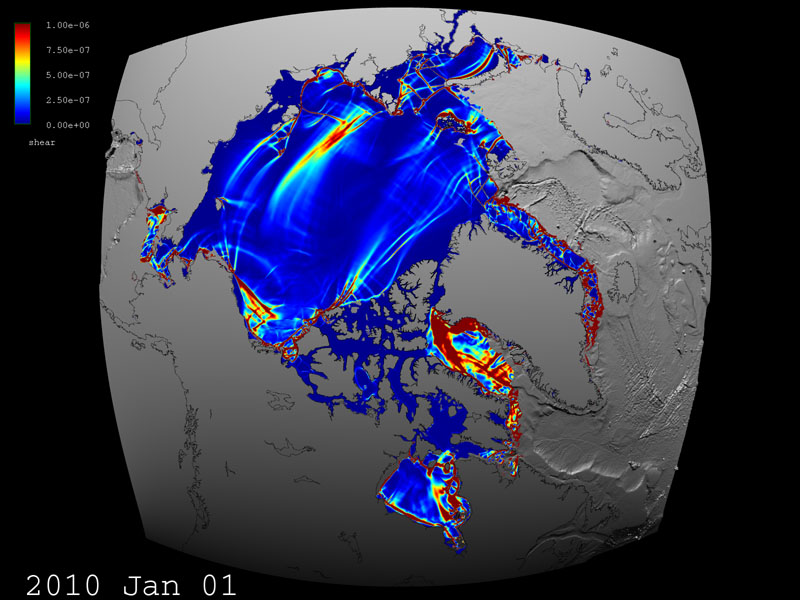
Two global, eddying, data-constrained ocean and sea-ice model solutions generated by the ECCO Phase II (ECCO2) project are being used to drive ecosystem and biogeochemical models, and to study ocean-cryosphere interactions.

Project Details
The first solution was obtained for the period from 1992–present using a low-dimensional Green's function approach to estimate several dozen model parameters. The second solution was obtained for the periods from 2004–2005 and 2009–2010 using the adjoint method to estimate around two billion model parameters.
In contrast to other global eddying ocean data assimilation solutions, the ECCO2 solutions are consistent with model equations throughout the period of optimization; thus they conserve tracer quantities. Tracer conservation makes these solutions particularly well suited for heat and freshwater budget analyses, and for driving biogeochemical simulations. The availability of the adjoint model can help identify the dominant water mass pathways, time scales, and dynamical processes of ocean-ice interactions.
Results and Impact
Such data-constrained ocean and sea-ice model solutions are important because remotely sensed and in situ observations are sparse compared to the scales and properties of ocean circulation. Although the ECCO2 solutions are experimental and preliminary in many ways, they are nevertheless already improving estimates and models of the ocean carbon cycle. ECCO2 results are being used to understand the recent evolution of the polar oceans, monitor the time-evolving term balances within and between different components of the Earth system, and address many other Earth system science questions.
Role of High-End Computing Resources
NASA supercomputing resources allow the ECCO2 project team to run the huge minimization problems that must be solved in order to constrain the numerical model with observations. These nonlinear optimization problems are among the largest ever undertaken—involving billions of observations and control parameters and trillions of predictive model variables.
Chris Hill, Massachusetts Institute of Technologycnh@mit.edu