High-Performance Computing for Extended Formation Flight
Overview
Just as migrating birds save energy by flying together, aircraft flown in formation can obtain a significant reduction in drag due to wake upwash from the lead aircraft. As the world's fleet of aircraft grows, formation flight offers a promising approach to reducing fuel consumption and carbon emissions on long-range flights. NASA's Fundamental Aeronautics Project is performing high-fidelity simulations of formation flight aerodynamics to provide more accurate predictions of the drag reduction and energy savings it could provide.

Project Details
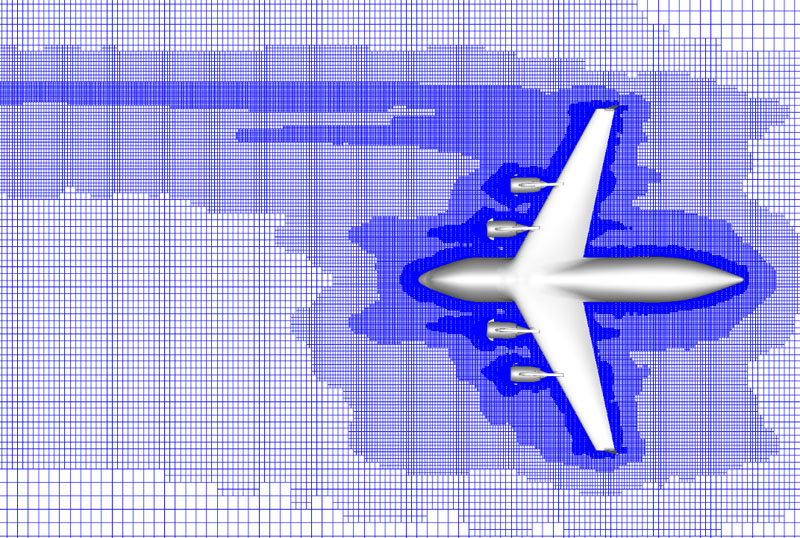
Formation flight simulations pose a significant challenge since they hinge on accurately predicting and measuring the induced drag of complete aircraft at transonic conditions, and accurately propagating vortices and wakes over long distances through a computational domain. In extended formation flight, operational safety regulations dictate separation distances of 15-50 wingspans between planes, further increasing the scale and difficulty of the simulations.
These challenges are met by using a non-body-fitted simulation approach on computational meshes that are dynamically adapted to minimize errors in the induced drag results. The simulations include the effects of flow compressibility, non-planar wakes, and other important phenomena that are lacking in low-order approaches.
Results and Impact
Results from these simulations are verified with flight-test data being generated cooperatively with other government agencies. After validation, these data are used in models of the National Airspace System to understand the potential of formation flight to reduce fuel consumption on a national scale.
Role of High-End Computing Resources
Formation flight involves aerodynamic phenomena spanning lengths from miles to millimeters. This extraordinary range of scales, combined with the output's sensitivity to slight errors, makes these analyses very challenging. With problem sizes that are on the order of a billion degrees of freedom, and with hundreds of cases to consider, the availability of NASA's high-end computing resources is key to this research.
Michael Aftosmis, NASA Ames Research Centermichael.aftosmis@nasa.gov James Kless, NASA Ames Research Center
james.kless-1@nasa.gov