"Inverted Tornado" in the Solar Turbulent Convection
Overview
Observations of the oscillatory behavior of the solar surface provide information about the Sun's photospheric and internal dynamics. The combination of observations from the Helioseismic and Magnetic Imager on the Solar Dynamic Observatory with realistic radiative hydrodynamic simulations has proven to be an excellent tool to better understand complicated, turbulent phenomena on the Sun.
Project Details
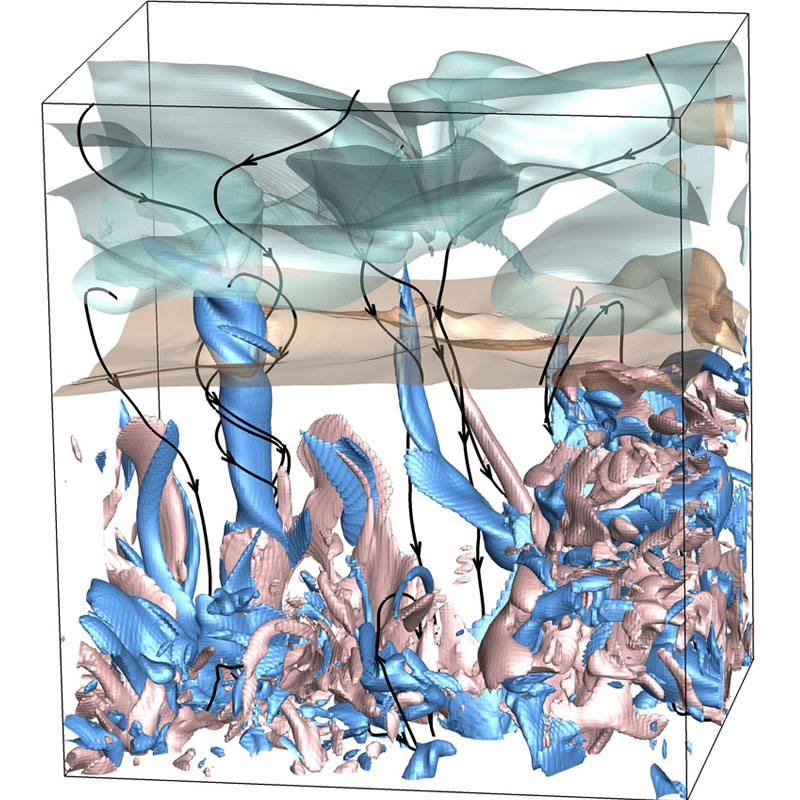
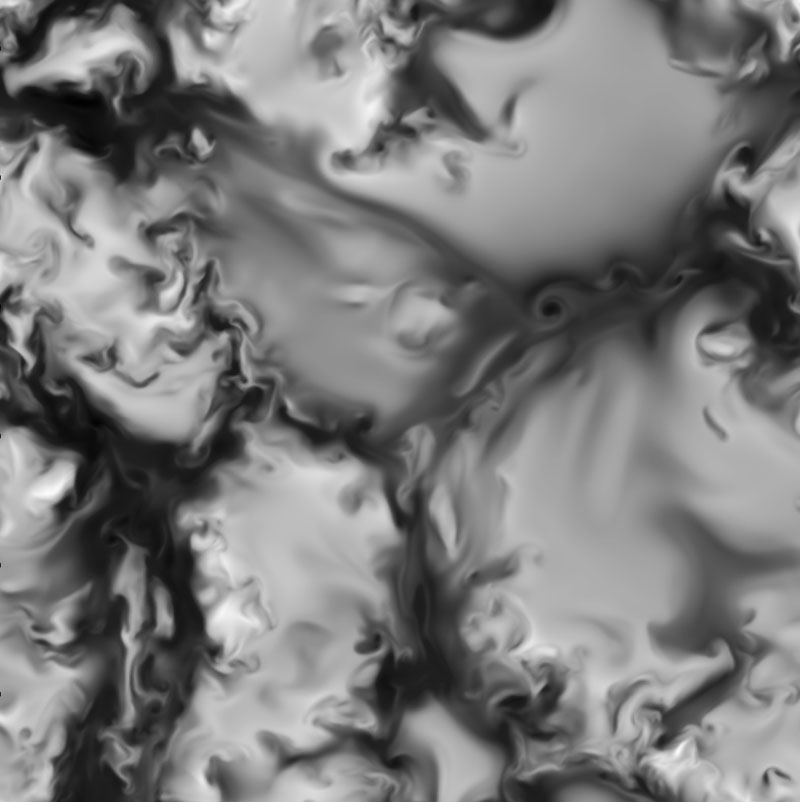
Strong vortex flows are created in downdrafts when the plasma returns to the solar interior after radiating its energy at the surface and cooling down. These spiraling vortex motions are reminiscent of tornado flows on the Earth. Numerical simulations of turbulent convection on the Sun predict these "solar tornadoes" to have diameters of 500 kilometers.
The simulations have allowed us to investigate solar phenomena at scales unresolved by modern telescopes. The results have revealed "inverted tornados," a new phenomenon in which vortex tubes form with supersonic swirling flows. Our work has also uncovered the mechanism that drives acoustic wave excitation on the Sun.
Results and Impact
Numerical models are important for validating and improving solar observation (helioseismology and asteroseismology) techniques, for supporting the Solar Dynamics Observatory and Kepler missions, and for preparing future instrumentation.
Role of High-End Computing Resources
Realistic 3D radiative hydrodynamic numerical simulations require massive computational resources. To accomplish these analyses, we use the Pleiades supercomputer at the NASA Advanced Supercomputing facility. Pleiades has demonstrated highly efficient performance for these massive parallel computations.
Irina Kitiashvili, Stanford Universityirinasun@stanford.edu Nagi Mansour, NASA Ames Research Center
nagi.n.mansour@nasa.gov