Understanding the "Crack" in Earth's Magnetosphere
Overview
Earth and other planets are engulfed in the Sun's atmosphere, which extends outward about 10 billion miles. The Earth's dipole magnetic field shields us from most of the Sun's effects and its frequent storms. However, the shielding is not perfect and, through a process called magnetic reconnection, the solar wind is able to penetrate, or "crack," Earth's magnetosphere.
This cracking, called "space weather," can affect the Earth and its technological systems, and has caused over $4 billion in satellite losses alone. Our goal is to use petascale kinetic simulations to develop a more complete understanding of the causes and conditions leading to the development of this crack in the magnetosphere.
Project Details
Modeling the kinetic magnetosphere poses a difficult computational challenge because processes occurring on the smallest (electron) scales affect the global dynamics of the magnetosphere. To address this challenge, we are pioneering the development and use of state-of the-art kinetic simulations running on massively parallel computers.
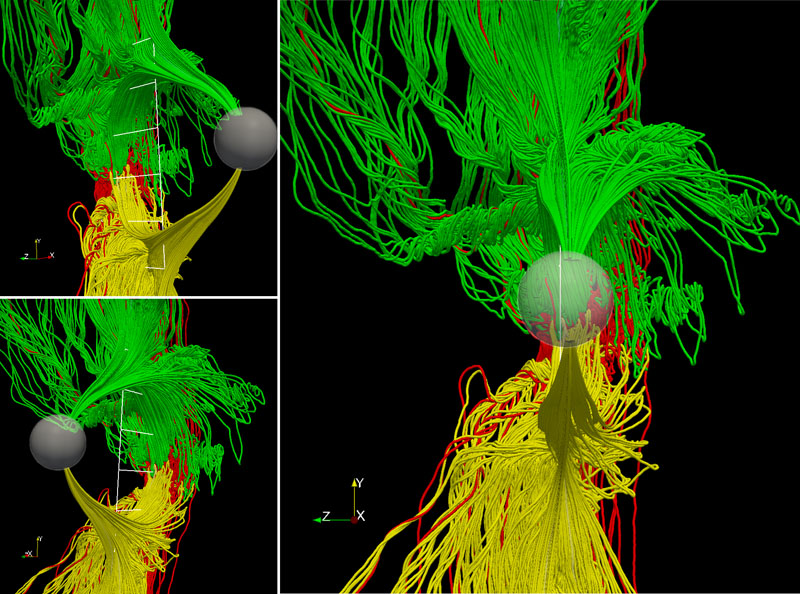
Using these simulations, we have obtained the first glimpse into the complex processes initiated on electron scales, which in turn give rise to the development of large-scale structures observed in spacecraft data.
Results and Impact
Our kinetic particle simulations are critical to understanding the space weather that results from the complex interaction between the solar wind and Earth's magnetic field.
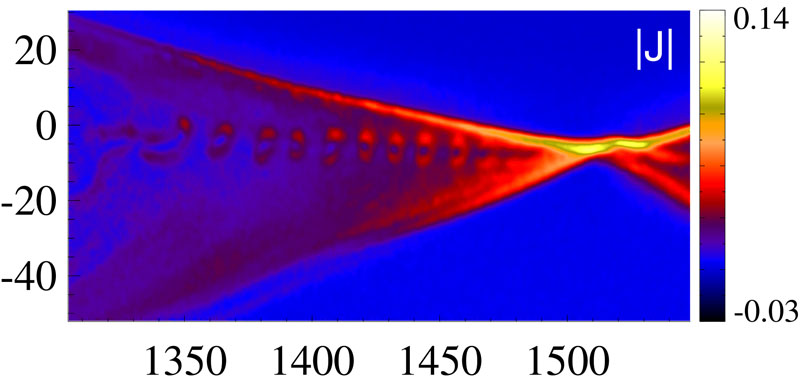
The figure above shows the discovery of electron-scale vortices that are generated under certain conditions in the magnetosphere. These vortices lead to the formation of flux ropes and play a role in transporting plasma from the solar wind into the magnetosphere.
These simulations are being used both to help guide the analysis of data from existing NASA missions, and to plan NASA's upcoming Magnetospheric Multiscale (MMS) mission. The primary goal of the MMS mission is to detect and make detailed measurements of electron-scale features in the magnetosphere that are thought to have global consequences.
Role of High-End Computing Resources
NASA supercomputing resources such as Pleiades have enabled us to leapfrog existing state-of-the-art magnetospheric models. In the process, we have achieved closure on several longstanding issues related to kinetic processes operating in the magnetosphere, such as the role of certain types of waves in reconnection and the discovery of electron-scale vortices that affect the crack in the magnetosphere.
Homa Karimabadi, University of California, San Diego/SciberQuest, Inc.homa@ece.ucsd.edu Tamara Sipes, University of California, San Diego/SciberQuest, Inc.
tbsipes@gmail.com