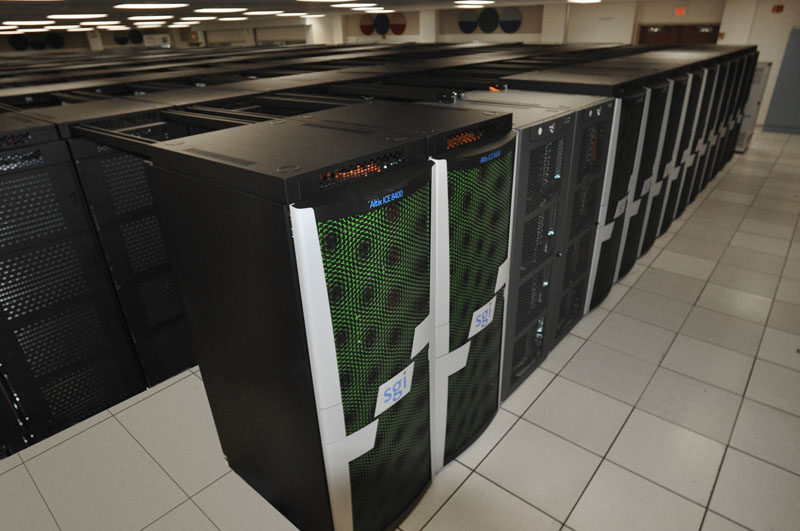
High-End Computing Capability Project: Passing the Petaflop Barrier
Overview
The High-End Computing Capability (HECC) Project provides an agency-wide compute environment that enables science and engineering across all of NASA's mission directorates. Meeting that challenge requires an environment that is reliable, stable, and expandable. This year, HECC expanded the Pleiades supercomputer to over 1 petaflop of sustained performance, augmented its data archive and file systems, and greatly enhanced its support services and tools.

Project Details
Since 2010, the HECC Project has continued to expand its computational resources and capabilities, with a focus on augmenting the supercomputing support services for its users. HECC increased the compute capability available to NASA's missions by 35% with the addition of 2,176 new nodes to Pleiades. Another 64 nodes of NVIDIA M2090 graphics processing units (GPUs) were also added to enhance concurrent visualization capabilities. Improvements to the file system provided a 3-fold increase in capacity and a 10-fold improvement in I/O operations per second. The capacity of the data archive was also doubled this year.
These hardware enhancements were also teamed with improvements in the delivery of HECC services and tools that enhance users' experience and effectiveness in harnessing HECC resources. For example, numerous improvements were made to the scheduler, I/O fabric, and Lustre file systems. The HECC webpage was also revamped to improve communication and accessibility of key information, and to enhance the users' experiences with the HECC environment.
Tools were developed to monitor user connectivity, enabling the network team to proactively work with users to improve transfer rates. The systems team also developed monitoring tools to identify problematic I/O patterns, enabling them to recommend more advantageous access patterns or pair the user with file systems that best met their pattern. The applications team developed tools to better identify code performance issues and worked with users to implement performance improvements.
The end result was a system that has kept pace with the continually growing demand, and offers the flexibility to run multiple, individual jobs, using anywhere from one node to thousands of nodes. Even with the rapid growth achieved, the stability of the system has improved. The entire project is committed to user success.
Results and Impact
HECC continues to provide a world-class high-end computing environment to all of NASA's mission directorates. The hardware and services have enabled a broad set of science and engineering that is being highlighted by other demonstrations detailed on this website.
Role of High-End Computing Resources
This project provides the high-end computing hardware and services at the NASA Advanced Supercomputing facility at Ames Research Center.
William Thigpen, NASA Ames Research Centerwilliam.w.thigpen@nasa.gov