Time-Accurate CFD Simulations of the Orion Launch Abort Vehicle in the Transonic Regime
Overview
Steady-state computational fluid dynamics (CFD) simulations of the Orion Launch Abort Vehicle (LAV) have shown significant asymmetries in the aerodynamic flow around the vehicle at certain points in its abort trajectories.
Asymmetric flow was observed in cases where the LAV was modeled at transonic speeds (Mach 0.8–1.2) with its abort motors firing. In some cases, the asymmetric aerodynamics resulted in side forces large enough to overpower the vehicle's attitude control motors.

The Propulsion Fluid Dynamics Branch at NASA Marshall Space Flight Center is performing higher-fidelity, time-accurate CFD simulations to investigate the causes of the flow asymmetries observed in the former steady-state analyses.
Project Details
Previously, CFD simulations of the Orion LAV were performed as steady-state (not evolving in time), 3D analyses with symmetric geometries. The vehicle was modeled with no freestream sideslip angle in its orientation, and with various combinations of abort motors and attitude control motors firing. The cases that exhibited asymmetric aerodynamics were in the transonic regime, with the LAV oriented at 0º and ±5º angles of attack. Asymmetries occurred in cases with the abort motors firing, either with or without the attitude control motors firing as well.
Results and Impact
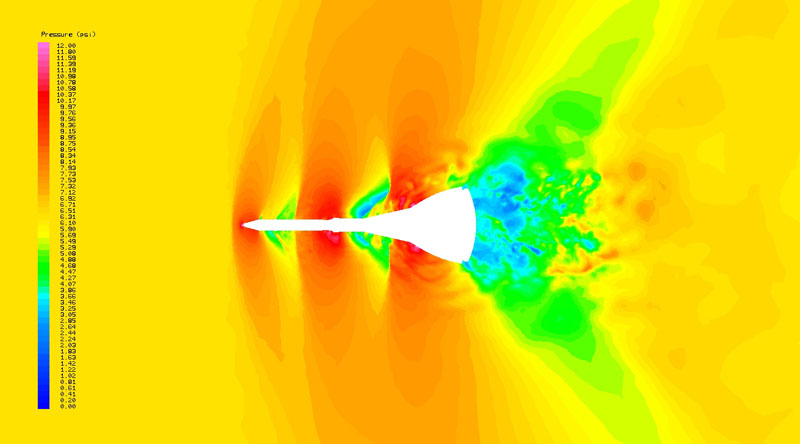
Initial time-accurate simulations have shown large amplitude oscillations in the unsteady aerodynamic forces acting on the LAV and Orion capsule. These results show that the physics associated with this problem are inherently unsteady and require time-accurate simulations to capture correctly. Future work is required to validate these results and to complete time-accurate simulations of additional transonic abort conditions.
Role of High-End Computing Resources
NASA supercomputing resources enable use of a highly parallel CFD tool used for time-accurate simulations of the LAV. Without such resources, the intensive analyses required for this effort would not have been possible.
Josh Rojahn, NASA Marshall Space Flight Centerjosh.m.rojahn@nasa.gov