Simulating the Formation of Dwarf Galaxies
Overview
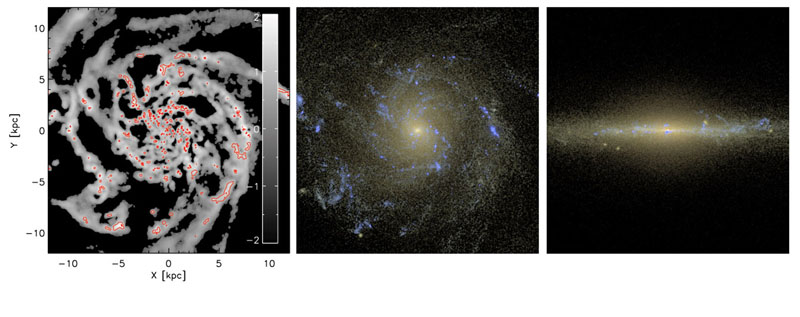
The theory of cold dark matter, first published in 1984, states the vast majority of matter in the universe—as much as 75 percent—is made of "dark" material. This dark matter does not interact with electrons or protons and, therefore, cannot be observed from electromagnetic radiation. Since its introduction, the theory has had one major flaw: it predicts that most galaxies should have far more stars and dark matter at their cores than they actually do. This problem is most pronounced in dwarf galaxies, which contain less than 1 percent of the number of stars in large galaxies such as the Milky Way. To study this anomaly, we simulated the cosmological formation of dwarf galaxies using NASA's supercomputing resources.
Project Details
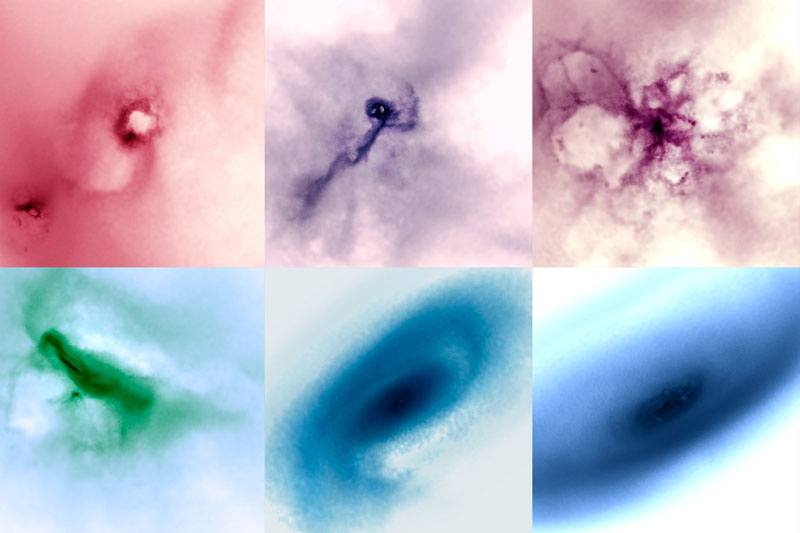
For this project, we simulated the formation of dwarf galaxies, including the expansion of the universe and the complex, 3D topology of dark matter distributions. Millions of resolution elements were used to model the gravitational and hydrodynamical forces involved in the formation of dwarf galaxies. Our simulations utilized a parallel Tree+ smoothed particle hydrodynamics code named GASOLINE, and employed several hundred processors.
Results and Impact
Our research revealed that blasts from massive stars exploding into supernovas generated enormous winds, which swept huge amounts of gas away from the center of what otherwise would have become regular-size galaxies. These blasts prevented millions of new stars from forming, leading to the creation of dwarf galaxies. The sudden removal of so much mass from the center of these galaxies diminished the pull of gravity on the local dark matter, enabling it to drift away. This is similar to what would happen if our Sun suddenly disappeared and the loss of its gravitational pull allowed the Earth to drift off into space.
Role of High-End Computing Resources
If a standard desktop computer was to run one of our simulations, it would take over 100 years to complete. To expedite the computation time, we use hundreds of processors simultaneously on NASA's Pleiades supercomputer. Our simulations have consumed several million processor-hours to date, and have produced over a terabyte of data.
Fabio Governato, University of Washingtonfabio@astro.washington.edu