Modeling and Simulation Support for NASA's Space Launch System
Overview
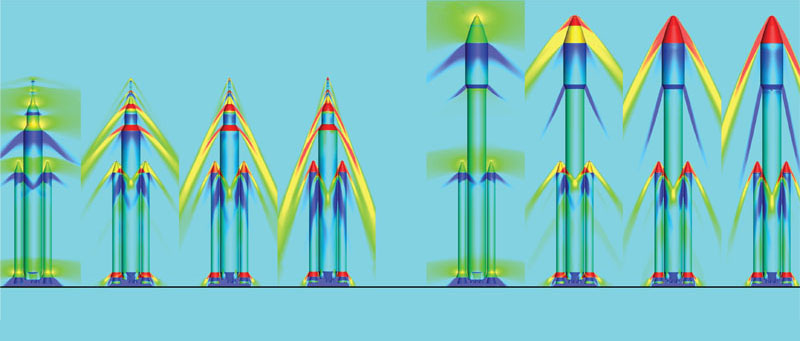
Computational fluid dynamics (CFD) simulations are supporting the design of NASA's next generation, heavy-lift Space Launch System (SLS), which is being developed to carry large payloads for crewed exploration beyond low Earth orbit. CFD simulations of SLS ascent aerodynamics are performed to characterize the aerodynamic performance of various designs, provide aerodynamic loads for structural analysis, and estimate surface pressure signatures for acoustic analysis. Results from these analyses enable designers and engineers to optimize the vehicle's shape for better performance, and to assess the structural and acoustic loads that the vehicle will encounter during ascent.
Project Details
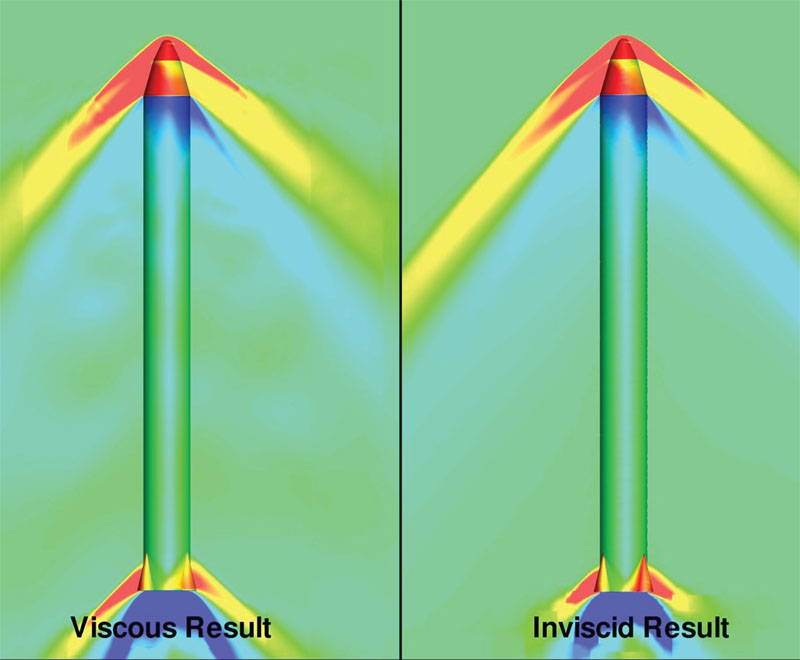
Modeling and simulation experts are performing CFD simulations of the SLS at select points throughout the ascent trajectory. Results of the simulations are used to predict and compare the aerodynamic performance and loads of different vehicle designs. These comparisons enable the SLS design team to optimize the vehicle's shape for better performance.
CFD analyses also provide line loads and pressure signatures that engineers use to assess the structural loads and acoustics that the vehicle will encounter during ascent. CFD-generated databases of aerodynamic forces and moments also assist in the development of ascent trajectories for various mission requirements.
Results and Impact
Results from ongoing CFD simulation have been used to make critical, early design decisions for the SLS before experimental or flight data could be obtained. CFD support for SLS development will continue to advance as the vehicle design matures. Key design areas that CFD results will impact include:
- Outer mold line (exterior shape) of the vehicle
- Type, number, and layout of rocket engine motors
- Amount of thermal protection material needed
Role of High-End Computing Resources
The NASA Advanced Supercomputing facility's high-end computing resources enable fast and efficient turnaround time for CFD simulations of the SLS. The Pleiades supercomputer allows viscous aerodynamic databases–comprised of hundreds of simulations–to be completed in under a week using 256 cores per simulation. Databases of more than 1,000 inviscid simulations, which are slightly less computationally intensive than viscous solutions, have been completed in approximately 3 days using 12 cores per simulation.
Cetin Kiris, NASA Ames Research Centercetin.c.kiris@nasa.gov Jeffrey Housman, NASA Ames Research Center
jeffrey.a.housman@nasa.gov