Simulating the Ares I Scale Model Acoustic Test Using CFD
Overview
NASA regularly uses computational fluid dynamics (CFD) simulations to assess the loads and risks for space vehicles at liftoff. Ideally, these simulations begin early in the development process, and allow engineers to quickly evaluate numerous design options that would be difficult to assess with traditional methods. Quick iteration allows engineers to rapidly explore the issues and benefits of potential design concepts and provides better value for taxpayer dollars.
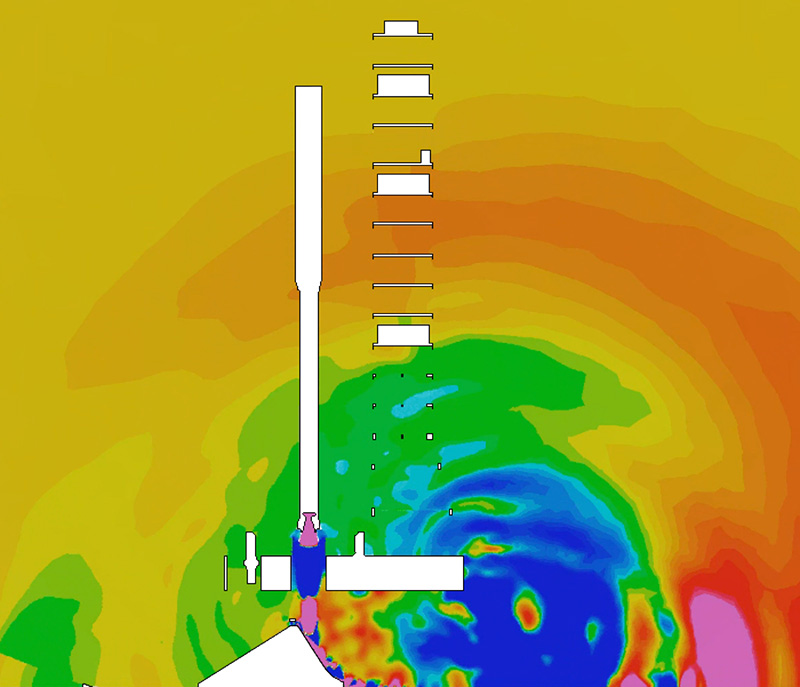
To have confidence in the results from these simulations, however, their accuracy must be anchored to real-world measurements. Recently, such validations have been performed using data from Ares I scaled rocket tests at Marshall Space Flight Center. These validation tests have demonstrated the ability of modern CFD tools to accurately simulate the transient startup environment of a rocket at liftoff.
Project Details
The Ares I Scale Model Acoustics Test (ASMAT) was a series of live-fire tests of a scaled rocket motor intended to simulate the acoustic conditions of the full Ares I vehicle at launch. The test's primary goals were to validate the acoustic environment and loads of the vehicle. In addition, the test also provided a well-documented set of high-fidelity measurements that were useful for validating CFD results.
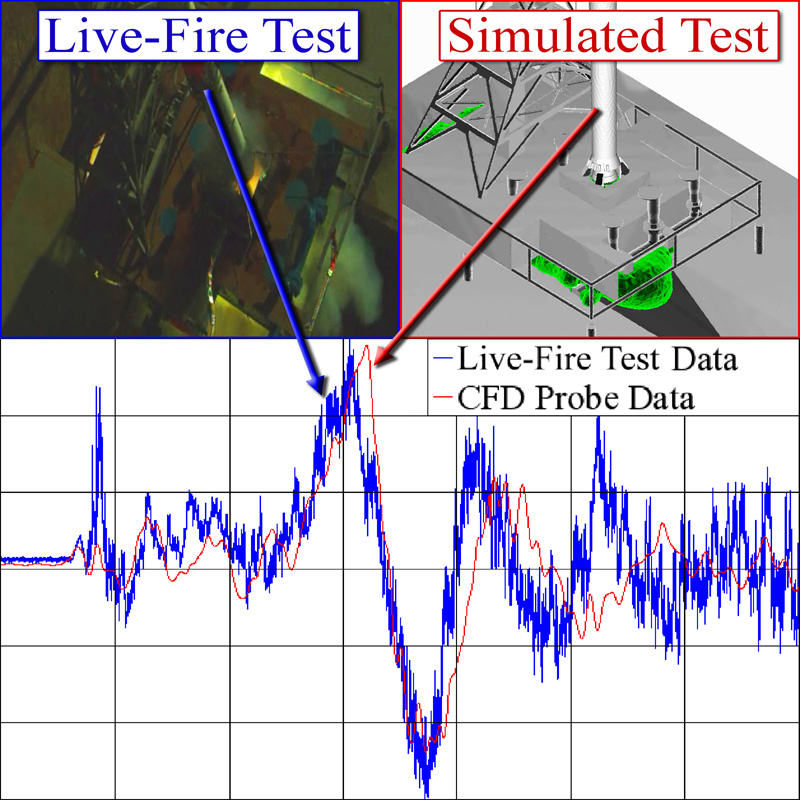
Simulations of the ASMAT motor firings were performed before live-fire tests to predict the rocket performance and the startup environment at liftoff. These simulations were then compared against the measured data after the tests to evaluate the accuracy of the CFD methods and their applicability for future work.
Results and Impact
Results from the simulations have been compared to a range of pressure measurements from the physical test setup, as well as to visible and infrared imagery of the tests, and have shown excellent correlation to real-world results. These initial findings have helped provide the confidence to move forward with full-scale simulations of liftoff environments for future launch vehicles, such as the Space Launch System.
Role of High-End Computing Resources
Using CFD to predict acoustic effects for a structure the size of a launch pad is an intense computational task, and one that would be extremely difficult without the availability of supercomputers such as Pleiades.
Even simulations of a scaled-down rocket took nearly a week to complete while running on over 1,000 processors. These simulations were usually executed in groups of three or more to test design permutations. In addition, each simulation requires multiple terabytes of storage to accommodate the hundreds of individual gigabyte-scale files necessary for visualization, post-processing, and data analysis.
Gabriel Putnam, NASA Marshall Space Flight Centergabriel.c.putnam@nasa.gov