Supersonic Nozzle Design for Low-Noise/High-Thrust at Takeoff
Overview
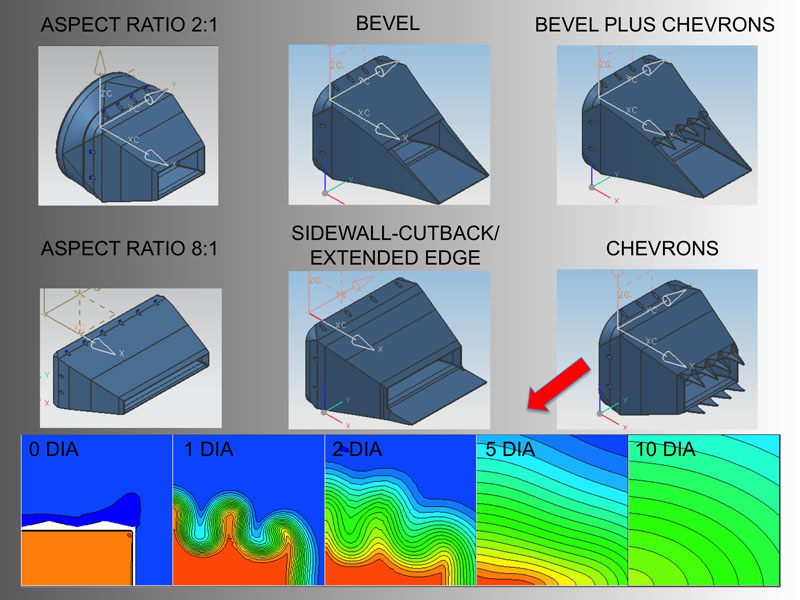
The Supersonics Project within the Fundamental Aeronautics Program at NASA has been investigating nozzle design concepts for commercial supersonic transports entering service around the 2018-2020 "N+2" timeframe. Noise-suppression technologies have been integrated into nozzles with a goal of reducing noise at takeoff while maintaining high thrust. Reynolds-Averaged Navier-Stokes (RANS) computational fluid dynamics (CFD) simulations support aerodynamic screening of the concepts and provide input for Acoustic Analogy noise prediction codes.
Project Details
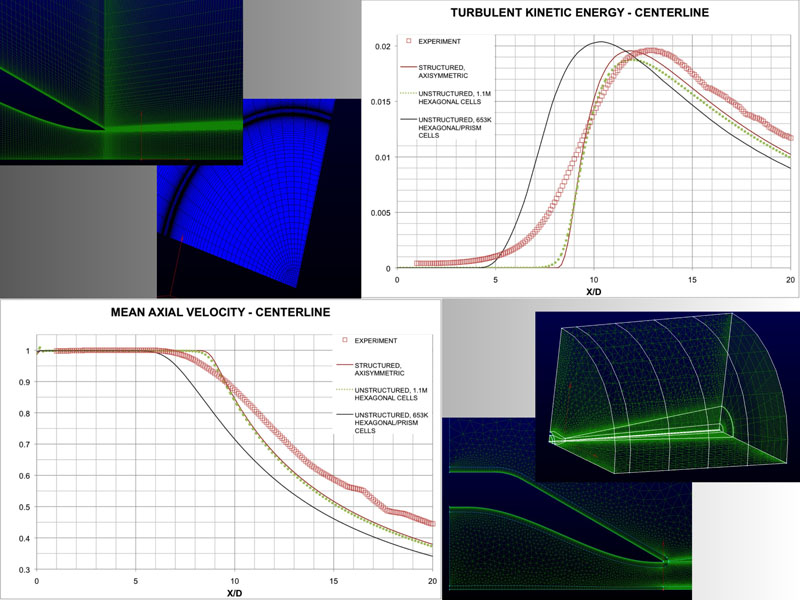
The Wind-US RANS CFD code's structured and unstructured flow solvers, coupled with the two-equation Menter shear stress transport turbulence model, are being run to provide the aerodynamic and turbulent parameter inputs for RANS-calibrated noise prediction codes. Predictions for baseline nozzles and more complex nozzles have been compared to experimental results as part of the overall verification and validation efforts for the CFD and noise tools.
Analyses have been performed with the RANS CFD methodology to screen and map out the design space for integration of various noise-suppression technologies into three-dimensional nozzles. The technologies investigated thus far include chevrons, ejectors, beveled/aft-deck extensions, and rectangular nozzles with varying aspect ratios.
Results and Impact
Predicted mean flow and turbulence parameters are more accurately predicted following recent updates to the Wind-US code's structured and unstructured flow solvers. Wind-US analyses have helped guide the Extensible Rectangular Nozzle design process to minimize flow non-uniformities over a range of conditions. The validated unstructured solver within Wind-US provides another tool for use with complex nozzle geometries to increase engineering and computation efficiencies.
Screening complex nozzle geometries with CFD is a critical first step prior to fabricating costly test hardware. Future systems designers will use the output from validated RANS CFD simulations along with output from validated Acoustic-Analogy-based noise prediction codes, which rely on RANS CFD input, to perform propulsion system trade studies with new noise-suppression technologies.
Role of High-End Computing Resources
The supercomputing capabilities at NASA have been instrumental in running multiple nozzle concept cases and conditions using RANS CFD solvers. The Pleiades supercomputer at the NASA Advanced Supercomputing facility has provided the computational architecture to obtain timely insights during the conceptual design process. Pleiades has ample computing power to run larger grids for more accurate comparisons with experiments. Access to large amounts of storage space, combined with high-throughput networks, has been essential for the most complex, grid-intensive cases.
Franco Frate, NASA Glenn Research Centerfranco.c.frate@nasa.gov