Live, Real-Time Demonstrations of 40-to-100-Gbps File Transfers Across WANs
Overview
Overcoming throughput bottlenecks in large file transfers over wide area networks (WANs) is critical to sharing data from NASA's Earth Science programs. Through an initiative led at NASA Goddard Space Flight Center, network engineers are investigating new high-performance workstations, disk configurations, and 40- to 100-gigabit per second (Gbps) network interfaces to resolve these bottlenecks.
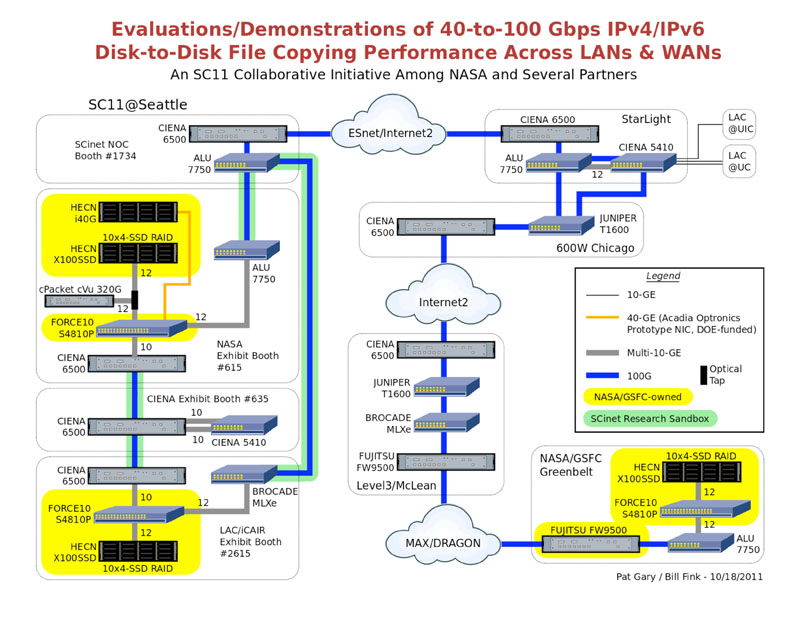
In cooperation with several partners, the NASA Goddard's High-End Computer Network (HECN) Team will conduct live, real-time demonstrations of 40- to 100-Gbps file transfer experiments between the NASA exhibit at SC11 (booth 615) and NASA Goddard in Greenbelt, MD, across 100-Gbps local and wide area networks.
Project Details
New technologies featured in these demonstrations include:
- Intel Sandy Bridge EP processors and Supermicro X9DRi-F-O PCI Express (PCIe) Gen3-based motherboards with quad channels to memory
- OCZ Vertex 3 solid-state disk drives, LSI MegaRaid 9265/9285 series RAID controllers, and PCIe expanders from One Stop Systems
- Prototype 40-Gigabit Ethernet (pre-100GE) network interface cards developed by Acadia Optronics through a Department of Energy grant
- 100GE-capable 7750 routers from Alcatel-Lucent
Results and Impact
This initiative will benefit NASA's High-End Computing (HEC) Program, and will demonstrate a next-generation distributed, 100GE national network infrastructure. Key partners involved in these demonstrations with include: Acadia Optronics, ESnet, Internet2, the University of Maryland College Park's Mid-Atlantic Crossroads (MAX), Northwestern University's StarLight Exchange Facility, SCinet Research Sandbox, the University of Chicago's Laboratory for Advanced Computing (LAC), the International Center for Advanced Internet Research (iCAIR), Intel, Supermicro, Alcatel-Lucent, Ciena, Brocade, Juniper, Fujitsu, cPacket, Force10, and National LambdaRail.
Role of High-End Computing Resources
Using NASA Goddard's Science and Engineering Network (funded by the HEC Program's NASA Center for Climate Simulation) and several R&D WANs managed by our partners, the HECN Team achieved a throughput rate of nearly 30 Gbps when copying files over WANs last year at SC10. With our new workstations, we expect to demonstrate 40- to 100-Gbps file transfers over cross-country WANs during SC11.
Bill Fink, NASA Goddard Space Flight Centerbill.fink@nasa.gov

