Simulations of the Solar Interior
Overview
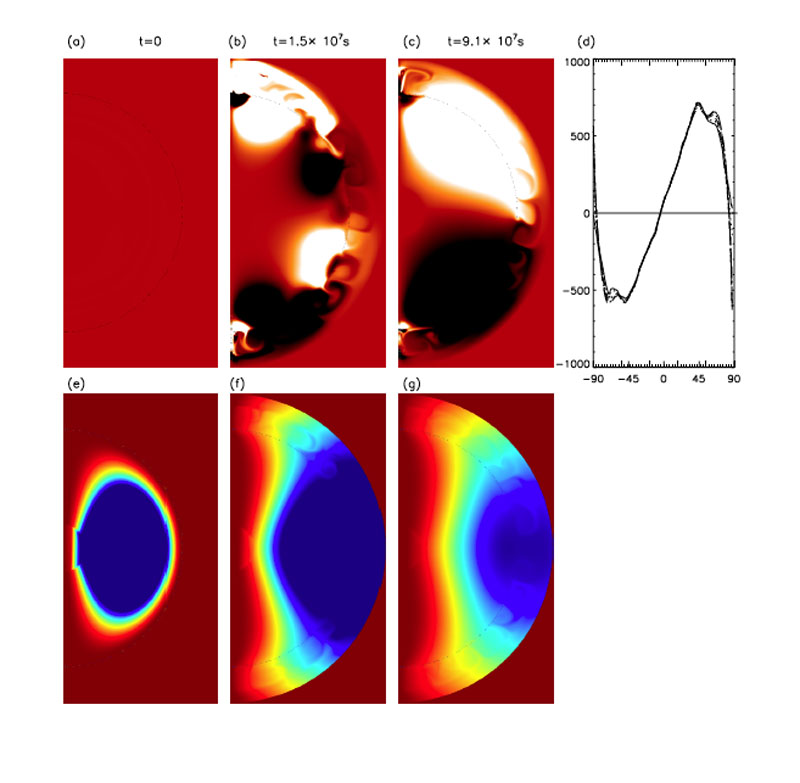
We perform numerical simulations of the deep solar interior, including the radiation zone as well as the convection zone, to better grasp the internal solar rotation. We strive to understand why the solar radiative interior rotates uniformly despite the presence of shearing forces induced by the overlying convection zone and tachocline (the transition region between the Sun's radiative interior and its differentially rotating outer convective zone). Previous studies have stressed the importance of treating the interface between the convective and radiative regions properly. This task is computationally difficult, as the relevant timescales for the two regions are extremely disparate.

Project Details
In these simulations, we self-consistently couple the convective and radiative regions of the Sun in order to get a faithful representation of the processes at the interface. These processes may contribute to angular momentum transport, such as magnetic pumping, wave generation, and convective overshoot.
Results and Impact
We find that uniform rotation of the radiative interior is maintained in the presence of shearing forces. The physical processes that maintain tachocline separation are those of convective overshoot and the secondary flows that they generate. The spectacular magnetic events observed on the solar surface are generated by a magnetic field that is fed by a hydromagnetic dynamo in the solar interior. A key part of the dynamo process is the stretching of the magnetic field by differential rotation. Therefore, understanding the differential rotation profile of the solar interior is crucial to comprehending the Sun's magnetic cycle. This contributes to NASA's goals by helping to interpret the Sun's interactions with the Earth, and identifying causes of variance in the Sun.
Role of High-End Computing Resources
The Sun's convective processes occur over relatively fast timescales, whereas its radiation zone is affected mostly by slow circulation and internal waves. This leads to coupling of very disparate timescales. Furthermore, for problems aimed at understanding the rotation of the Sun, we need to look at the global problem, covering the vast majority of the solar interior in full spherical coordinates. This requires high model resolutions, integrated over very large timescales. The computational resources and speed provided by NASA's Pleiades supercomputer enable this kind of intensive calculation and make our work possible.
Tamara Rogers, University of Arizonatami@lpl.arizona.edu